Tutorial
Learn how to choose a Professional Blockchain Validator using uptime, slashing risk, and infrastructure signals to stake confidently.

Staking is often approached as a yield-optimization exercise, but in practice, it is an infrastructure decision—if you’re new to staking, a foundational overview can help clarify the mechanics.
A professional blockchain validator operates production-grade staking infrastructure that determines reliability, participation in consensus, and long-term reward consistency. While implementation varies across Proof-of-Stake networks, these core principles remain consistent, though ecosystem-specific performance considerations can differ.
Many delegators compare commission rates or advertised returns, assuming that a higher yield is the primary objective. This assumption overlooks the more important variable: validator security, which encompasses a validator's reliability, configuration integrity, and operational resilience.
Beyond APR: Why Your Choice of Validator is a Security Decision
APR differences between validators are typically narrow in most mature networks. The more meaningful variation comes from infrastructure reliability.
In 2026, comparing headline APR is insufficient because it ignores Net Realized Return (NRR). A professional validator must now optimize for three distinct revenue streams: base protocol rewards, MEV-smoothing distributions, and Restaking multipliers (points or yield from layers like EigenLayer or Symbiotic). A validator with a slightly higher fee but superior MEV extraction and Restaking integration will often outperform a 'zero-fee' provider that lacks these technical capabilities.
The mechanism is straightforward. Reduced validator uptime leads to missed participation in block validation.
Missed participation results in lost rewards. Over time, these losses compound and can exceed any marginal savings in fees. A 1–2% commission difference is often smaller than the cumulative impact of repeated downtime.
This does not mean commission is irrelevant. In certain network conditions, fee differences can influence outcomes.
However, in most production environments, validator security and node reliability have a greater long-term impact than pricing differences. A validator is not a passive intermediary but a technical partner in your staking strategy, especially in more advanced models that involve restaking and extended validator roles.
A validator should therefore be evaluated as an operational risk surface. The objective is to preserve realized yield by minimizing avoidable failures.
115,344 clients stake with Imperator.co
115,344 clients stake with Imperator.co
Start staking with Imperator and maximize your rewards.
Beyond APR: Why Your Choice of Validator is a Security Decision
APR differences between validators are typically narrow in most mature networks. The more meaningful variation comes from infrastructure reliability.
In 2026, comparing headline APR is insufficient because it ignores Net Realized Return (NRR). A professional validator must now optimize for three distinct revenue streams: base protocol rewards, MEV-smoothing distributions, and Restaking multipliers (points or yield from layers like EigenLayer or Symbiotic). A validator with a slightly higher fee but superior MEV extraction and Restaking integration will often outperform a 'zero-fee' provider that lacks these technical capabilities.
The mechanism is straightforward. Reduced validator uptime leads to missed participation in block validation.
Missed participation results in lost rewards. Over time, these losses compound and can exceed any marginal savings in fees. A 1–2% commission difference is often smaller than the cumulative impact of repeated downtime.
This does not mean commission is irrelevant. In certain network conditions, fee differences can influence outcomes.
However, in most production environments, validator security and node reliability have a greater long-term impact than pricing differences. A validator is not a passive intermediary but a technical partner in your staking strategy, especially in more advanced models that involve restaking and extended validator roles.
A validator should therefore be evaluated as an operational risk surface. The objective is to preserve realized yield by minimizing avoidable failures.





Discover all our Staking Opportunities
Acces over 50+ protocols to maximize your staking returns
The Hallmarks of a Professional Blockchain Validator in 2026
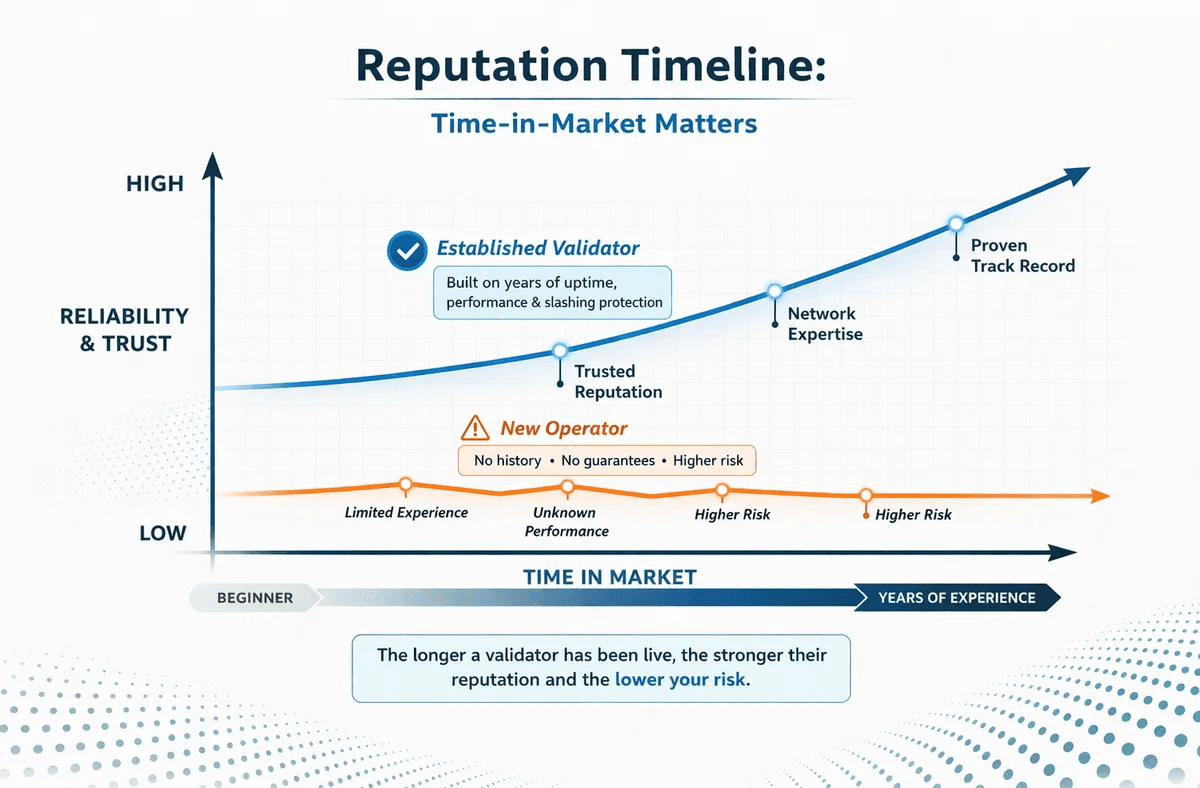
Primary signals include blockchain validator uptime and validator track record, ideally supported by a history of zero-slashing events. Validators with sustained uptime and no history of slashing demonstrate consistent participation and disciplined operations. Validators without publicly verifiable uptime or slashing history introduce unquantifiable risk.
Secondary signals relate to infrastructure design and operational discipline. Professional operators deploy multi-region systems across cloud and bare-metal environments, supported by 24/7 engineering rotations that ensure continuous monitoring and rapid response. This level of resilience aligns with the expectations of institutional staking, where reliability is non-negotiable.
Tertiary signals include transparency and participation in governance. While useful, these should not outweigh core performance indicators. Governance activity reflects alignment, but it does not substitute for infrastructure reliability.
Modern security is defined by the implementation of Distributed Validator Technology (DVT) and Threshold Cryptography. By utilizing tools like Horcrux or TMKMS, professional operators ensure that signing keys are never stored on a single vulnerable machine. This distributed approach provides a mathematical guarantee against double-signing, effectively neutralizing the most severe slashing risks that simpler setups remain exposed to
However, these claims must be verified. Delegators should review uptime dashboards, inspect slashing history on explorers, and confirm that operational data is consistently available. Always do your due diligence before.
Validator Evaluation Checklist
Uptime, Redundancy, and Direct Peering
While Sentry Nodes were once the standard for DDoS protection, the 2026 high-throughput era, led by chains like Hyperliquid and Monad, demands lower-latency solutions. Professional validators have transitioned to Direct Peering and gRPC-optimized streams. This architecture reduces the 'hop' distance between nodes, ensuring that your validator can propagate blocks at the sub-millisecond speeds required by modern, high-performance L1 networks.
Redundancy systems provide failover capability. When a primary node fails, a secondary system can assume operations with minimal disruption. Without this capability, even minor failures can result in downtime and missed rewards.
The Accountability Factor: Transparency and Community Standing
Applying these evaluation criteria in practice highlights what defines a professional operator. Imperator operates with a focus on infrastructure reliability, validator security, and protocol alignment.
Its architecture spans multiple regions, reducing exposure to localized failures and maintaining consistent validator uptime. Redundancy and failover mechanisms ensure continuity during infrastructure disruptions.
Security is implemented through a non-custodial model, where users keep their keys and retain full control over their assets. This is supported by advanced slashing protection mechanisms and continuous monitoring systems designed to detect and resolve issues proactively.
This operational scale is best demonstrated by our recent milestone of processing over 2.0 billion RPC requests for the Hyperliquid ecosystem. By supporting the latest HIP-4 Outcome Market infrastructure, Imperator provides more than just staking—we provide the foundational data layers that power the next generation of decentralized prediction markets and high-frequency trading tools.
Final thoughts on Choosing a Professional Blockchain Validator
Confident staking can only be achieved by selecting validators that demonstrate resilience, transparency, and disciplined operations.
Delegating to a professional blockchain validator ensures that your staking strategy is supported by reliable infrastructure and disciplined operations. With Imperator.co, delegators benefit from non-custodial staking, advanced security systems, and infrastructure designed for long-term performance.
FAQs
1. Does a lower commission mean a better validator?
Not necessarily. Lower commission improves nominal yield, but weaker infrastructure can reduce actual returns. A 1–2% fee difference is often smaller than losses from repeated downtime or missed rewards.
2. What happens to my funds if a validator goes offline?
Downtime typically results in missed rewards and may trigger penalties depending on the protocol. Penalty models vary, but slashing events are generally associated with more severe violations, such as double-signing or consensus faults.
3. Why should I stake with an established name like Imperator.co?
Established validators demonstrate consistent uptime, experienced engineering coverage, and reliable performance across networks. Imperator.co, which supports over 50 protocols, reflects the operational maturity expected of a professional validator.
$0 assets under managment
$0 assets under managment
Join investors who trust Imperator to maximize their returns. Take the first step today.