Research
Discover the Best XRP Validators on XRPL. Learn how UNL selection works, what validators do, and how to assess validator trust, transparency, and operations.

The best XRP validators are not defined by who offers the highest rewards or “fastest” performance. On the XRP Ledger (XRPL), XRP validators exist to support consensus correctness and network reliability. The XRP Ledger does not provide a direct economic incentive for contributing to consensus by running a validator. XRPL servers are configured with a Unique Node List (UNL), which determines which validation messages a server listens to during consensus.
This guide explains what XRP validators do, how XRPL validators participate in XRPL consensus, and how the Unique Node List (UNL) shapes validator selection in practice. You will also learn how to evaluate trust, transparency, and operational maturity without relying on hype or unverifiable claims about uptime.
What “Best” Means for XRPL Validators
On XRPL, “best” is not a single metric. It is a blend of trust and verifiability, not yield. A strong XRPL validator typically demonstrates:
The operator can be mapped to a public identity signal (registry metadata, consistent naming, accountable presence).
Resilient infrastructure practices, monitoring discipline, and cautious change management.
Observable presence in validator registries and explorer tooling used for verification.
Activities that improve visibility and safety for developers and researchers (documentation, tooling, registry hygiene).
Avoiding operator concentration and encouraging diverse independent participants in trust lists.
Because XRPL employs a UNL-based trust model, verifying the identity of a validator is crucial. A validator’s value lies in its credibility as a consensus participant, not in providing yield.
When people discuss validator performance, they often reference uptime and consistency. On XRPL, the rigorous approach is to verify observed participation and identity signals across multiple sources, rather than relying on a single claim.
Five XRPL Validator Operators and Verification Tools to Know
The names below are verification tools and examples of operators. Do not treat this as a ranked list or a claim of UNL status. Verify the validator's identity and status using primary sources, such as the UNL and validator tooling.
1. Imperator

Imperator is a Web3 infrastructure operator. Imperator also publishes XRPL-related chain services information (for example, snapshots, address book, live peers, endpoints). In the context of this guide, Imperator’s relevance is tied to verifiability: clear operator identity signals, conservative operations, and a reliability-first posture.
115,344 clients stake with Imperator.co
115,344 clients stake with Imperator.co
Start staking with Imperator and maximize your rewards.
2. Bithomp
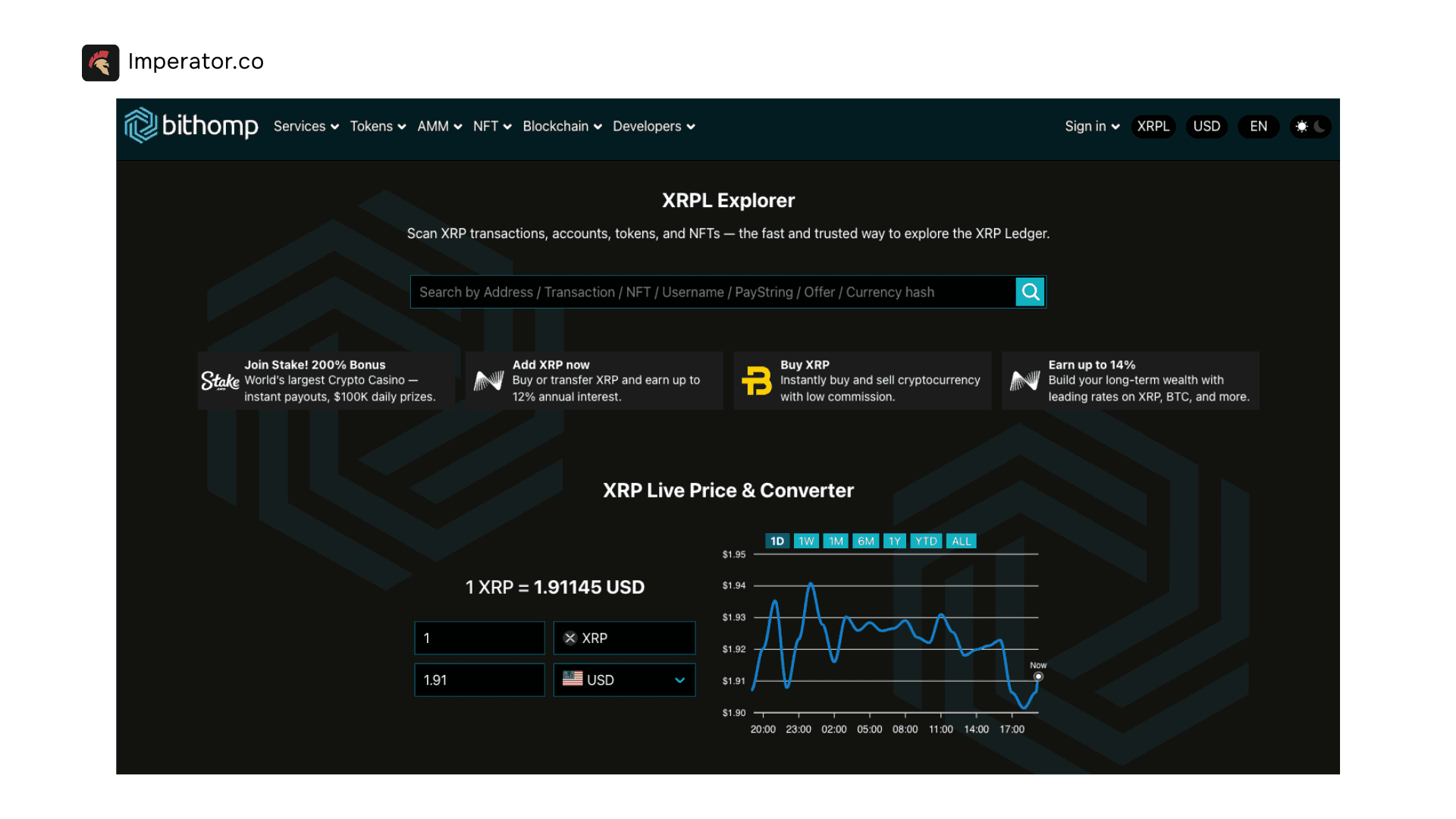
Bithomp is an XRPL explorer and transparency surface that helps users inspect network activity, accounts, and validator-related information. Explorer tooling is useful for verification workflows because it supports cross-checking public metadata and observed network behavior when evaluating XRP Ledger validators.
3. Vet_X0
Vet_X0 is a public operator identity discussed in the XRPL community. Verify validator metadata in registry tooling, then cross-check observed participation across multiple transparency surfaces.
4. xSPECTAR
xSPECTAR publicly documents operating XRPL nodes, including a validator node. Separately, the XRPL Foundation announced in November 2025 that xSPECTAR was removed from the UNL at its own request. Therefore, avoid implying current UNL membership without checking the latest UNL tooling.
5. XRPScan
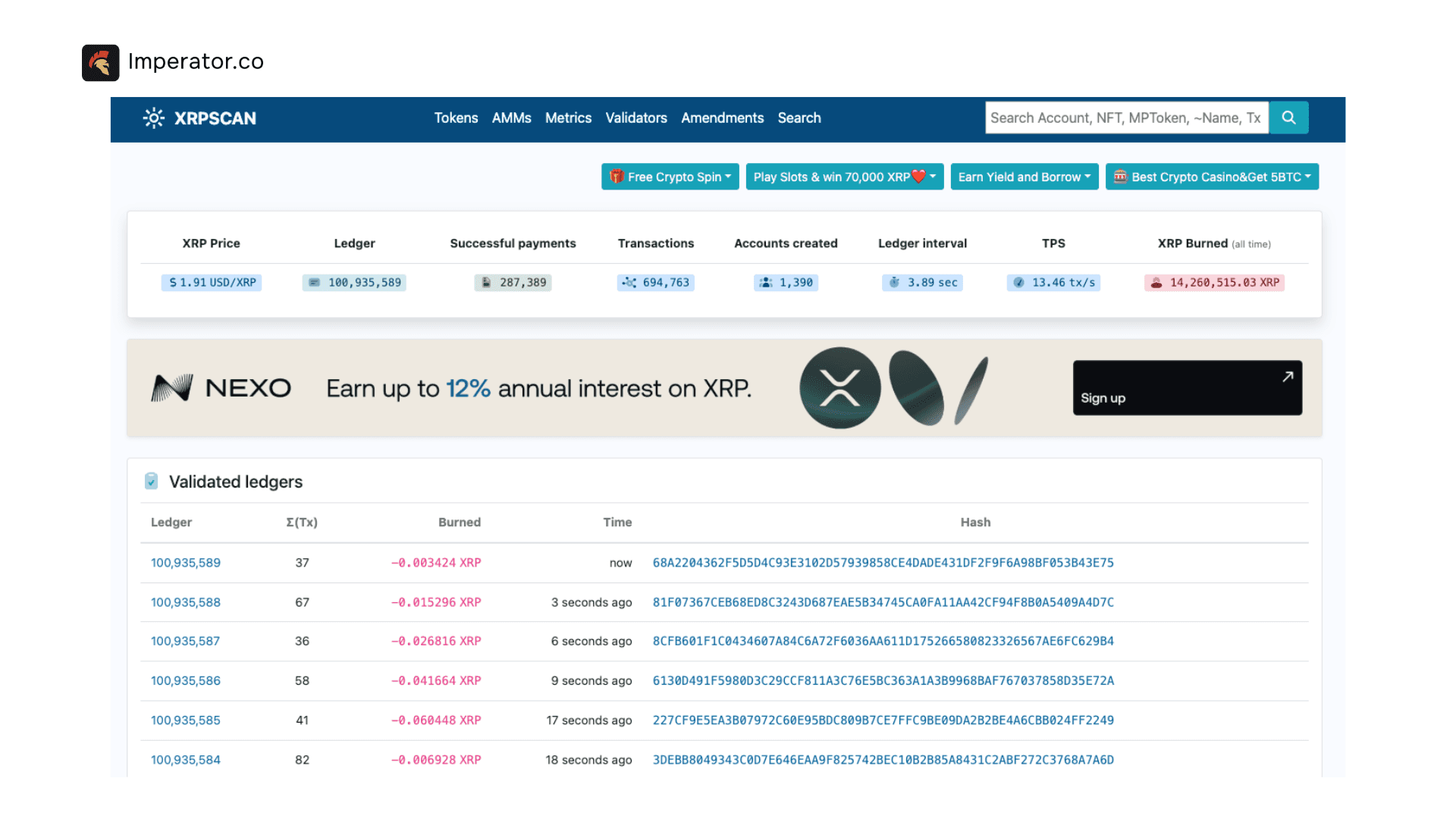
XRPScan is an XRPL explorer and registry surface that presents network and validator data in a user-friendly format. Registry-style views are valuable when you want a structured way to review operator metadata and reduce reliance on informal claims.
How do XRPL Validators Work?
An XRPL validator is a server running the XRPL node software in validator mode. Like other XRPL servers, it maintains a copy of the ledger and relays transactions. What makes it a validator is that it issues validation messages used during the XRPL consensus.
What do Validators do in Consensus?
The XRPL consensus is the mechanism that enables the network to agree on a single, authoritative ledger state without relying on Proof of Work mining or Proof of Stake block production.
XRPL employs a consensus algorithm that differs from Proof of Work and Proof of Stake. Validators that appear on a UNL can vote on amendments and fees, thereby assuming a role in the network’s evolution. The key point is that XRP Ledger validators exist to support correctness and continuity, ensuring the network converges on a consistent ledger history, rather than distributing yield.
The Unique Node List (UNL) and Validator Selection
Validator “selection” on XRPL does not work like Proof of Stake. There is no delegated stake deciding who produces blocks. Instead, XRPL servers rely on a Unique Node List (UNL). A UNL is a server’s list of validators that it trusts not to collude.
Every XRP Ledger server is configured with a UNL, which determines which validation messages it listens to and which it ignores during consensus. By default, XRP Ledger servers can be configured to use validator list sites published by the XRPL Foundation and Ripple, which provide recommended validator lists (often referred to as default UNLs or dUNLs). In September 2025, XRPL documentation stated that nodes using the default UNL had to migrate their configuration by September 30, 2025. It noted that the old configured UNL could expire on January 18, 2026, if not updated. This applies to nodes relying on the old XRPL Foundation UNL publisher settings. During consensus, the server primarily considers validation messages from validators on its UNL.
This matters because:
Trust is explicit: XRPL nodes do not treat all validators as equal.
Operator diversity matters: concentration in a few entities weakens decentralization assumptions.
Identity clarity matters: the UNL model depends on credible operator attribution.
When evaluating XRPL validators, you are assessing trust anchors for a consensus view, not selecting a yield provider.
What Do Validators Not Do?
XRPL does not provide a direct economic incentive for running a validator. Other blockchains may provide mining or staking rewards, but XRPL’s design choice is to have no direct protocol incentive for consensus participation. That means:
XRPL validator operation is not a protocol staking yield mechanism.
If a product describes fees as “staking commission,” those terms come from the third party product, not XRPL validator participation.
Any product marketed as XRP staking or “XRP yield” is separate from XRPL validator participation and should be evaluated as a third-party product with its own risks.
Evaluating the Best XRP Validators
1. Public identity and accountability signals
Start with identity. An operator that cannot be attributed is harder to trust under a UNL model.
Prefer validators where:
Operator metadata is consistent across registries and explorers.
Identity signals remain stable over time (no frequent renames or ambiguous attribution).
There is an accountable public presence that matches registry information.
Anonymous operators may be competent, but anonymity reduces accountability. On a trust-list model, identity clarity is a practical advantage.
2. Operational maturity and infrastructure posture
Operational maturity shows up as consistency.
Look for signals such as:
Stable validator metadata and predictable operational behavior.
Evidence of monitoring discipline (visible consistency, not marketing promises).
Conservative change posture during upgrades or ecosystem shifts.
When people mention validator performance, they often default to uptime. Treat uptime as an outcome supported by operations, not a marketing slogan.
3. Monitoring and independent verification
Avoid relying on a single source. Cross-check a validator’s presence and activity across multiple reputable transparency surfaces.
Use:
Explorer data for observed validation activity.
Validator registries for operator metadata.
Community references only as secondary context.
If a validator is difficult to confirm across tooling, treat that as a risk factor in your evaluation. In a UNL-based model, uncertainty is itself a material drawback.
4. Diversity of operators and concentration risk
Strong decentralization is not simply “many validators.” It is diverse, independently controlled validators.
Watch for:
Over-concentration in a small number of entities.
Multiple validators that appear linked to the same organization or infrastructure footprint.
A UNL composition that lacks geographic or organizational diversity.
On XRPL, these factors matter because the UNL trust model assumes non-collusion among validators you consider credible.
5. Governance posture and transparency
Validators can signal support for network changes and amendments. You do not need to agree with every operator, but you should prefer operators with transparent posture.
Stronger signals include:
Consistent, explainable posture on network changes.
Transparent reasoning when taking a stance on upgrades.
Stable participation patterns during periods of network change.
This is especially relevant for builders and researchers who track ecosystem reliability over time.
6. Keep commission and yield fees in the correct category
In Proof-of-Stake ecosystems, commissions and staking rewards are central to validator selection. On XRPL, they are not.
If you are evaluating a third-party XRP yield product, that is where fees, commission, lockups, and counterparty risk belong. Do not confuse those considerations with XRPL validator evaluation.
XRP “Staking” vs XRPL Validators
XRPL is not Proof of Stake. That means you cannot delegate XRP to XRPL validators to earn protocol staking rewards for holding or delegating XRP via validators. When you see XRP staking, treat it as a third party product concept, not an XRPL protocol feature. XRPL materials describe staking in general as a feature of many Proof of Stake systems, while XRPL uses a distinct consensus mechanism.
Where “XRP EVM Sidechain validator” Fits
An XRP EVM Sidechain validator is not the same role as an XRPL mainchain validator. Sidechains are distinct networks with their own consensus and validator sets, even when they are connected to the XRPL ecosystem narrative.
If you are evaluating validators, confirm which network you are evaluating:
XRPL mainchain validators participating in XRPL consensus.
Sidechain validators participating in a separate consensus environment.
This distinction avoids category mistakes when comparing “validator participation” across XRPL and XRPL-adjacent infrastructure.
Closing Thoughts on the Best XRP Validators
Prioritize trust, transparency, operational maturity, and ecosystem contribution over any promise of yield. XRPL relies on a Unique Node List trust model, so evaluate validators like infrastructure by verifying operator identity, cross-checking observable participation instead of trusting uptime claims, and favoring operator diversity to support decentralization. If you want to speed up the verification process without turning it into a popularity contest, keep operators like Imperator on your shortlist, as their public infrastructure resources can reduce guesswork when validating what you see.





Discover all our Staking Opportunities
Acces over 50+ protocols to maximize your staking returns
FAQs
1. What is an XRP Ledger validator?
An XRP Ledger validator is an XRPL server configured to participate in XRPL consensus by issuing validation messages that help the network agree on the next ledger state.
2. How do I evaluate the Best XRP Validators?
Use a verification-first approach: check public identity metadata in registries, cross-check in explorer tooling, assess observed consistency over time, and prioritize operator diversity to support decentralization.
3. Can I stake XRP directly with validators?
No. XRPL is not a Proof of Stake (PoS) protocol, and XRPL validators do not distribute protocol staking rewards. Most “XRP staking” refers to third-party XRP yield products.
4. Why choose an infrastructure operator like Imperator?
Because operator transparency, operational maturity, and evidence-based reliability reduce uncertainty in a trust-list model. Infrastructure operators are evaluated on repeatable signals, not slogans.
$0 assets under managment
$0 assets under managment
Join investors who trust Imperator to maximize their returns. Take the first step today.